Wednesday, August 13, 2008

just deserts

Many thanks to Arlene from Port Orchard Flowers for her kind comments about our flower snaps, and also to Dina in Texas aka The Girl Who Wished She Was Australian for her comments and interest in our humble ramblings. It is good to know that the readership has extended beyond family and close friends ( OK, probably only by 2, but it is appreciated).

We are now in Tennant Creek 502 km north of Alice Springs.We have found a great bush campsite outside town which fulfills all our requirements- remote, quiet, hot, and excellent wireless internet access! ** and just discovered it is $12 per night, so suspect we will be here tomorrow.

We left Alice to explore the East MacDonnell Ranges and experienced first hand the frustration of outback road signage- you travel 90 km along a tarmac track before you reach the sign which says 'dirt track next 400km, high clearance 4WD vehicles ONLY'.

There was a second reason to turn back however, as james dog had spent the morning vomiting theatrically all over the van.Being the organised and caring veterinary surgeon I had failed to pack any injectable anti-emetics and knowing that once she starts with her grumbling pancreas the results can be pretty messy we headed back to Alice. Another thanks therefore to Kathy at Alice Spring Veterinary Surgery for providing the necessary drugs to allow our onward journey to proceed.
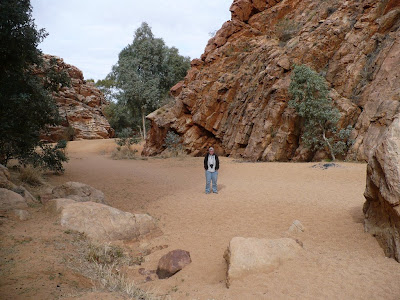

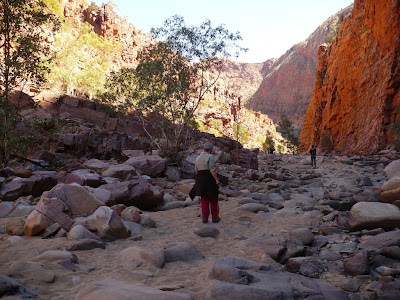
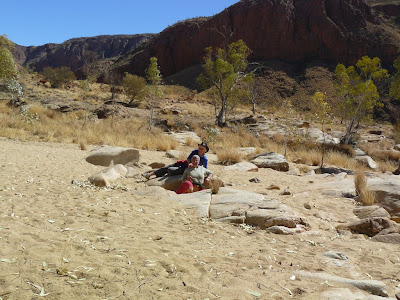
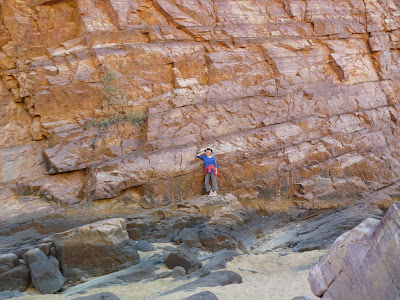
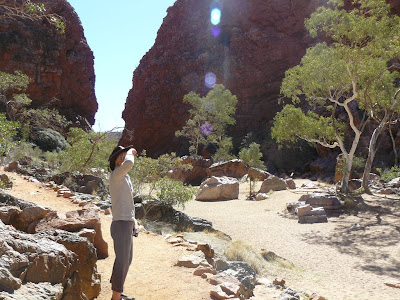
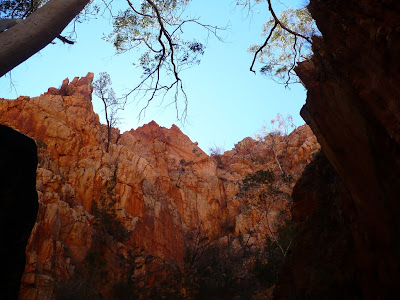
Above: Emily Gap East MacDonnell Ranges.

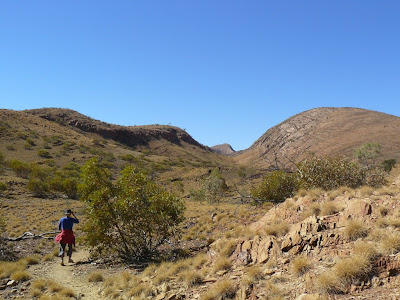
The trip north from Alice really is desert, desert and more desert. We camped at Gemtree, a fossicking campsite east of the main road where people flock to rifle through the rubble looking for gemstones ( garnet, zirconia ) but gave the fossicking a miss as it was very windy and wild.

Monday, August 11, 2008

flowers in the sand

Alice Springs desert park is a great venue; it has the best nocturnal animal house we have ever seen with the animals kept in large enclosures with the lighting and environments painstakingly matched with their natural habitat. So yesterday we got to see bilbys, bettong, hare wallabies, spinifex mice, phascogales,dunnarts, kultars and the spotted quoll- all extremely bizarre and wonderful creatures.

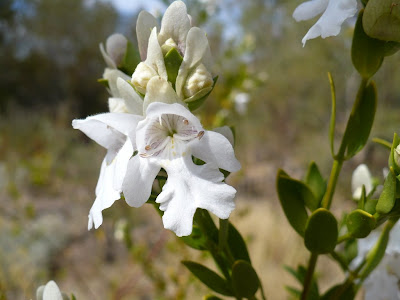
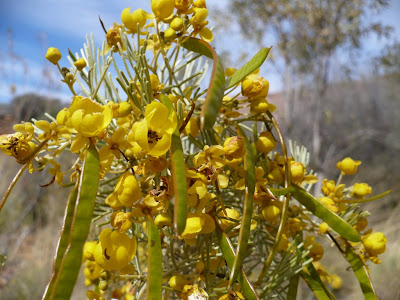
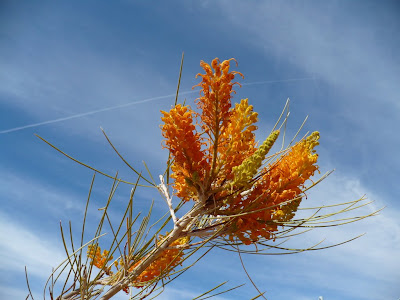
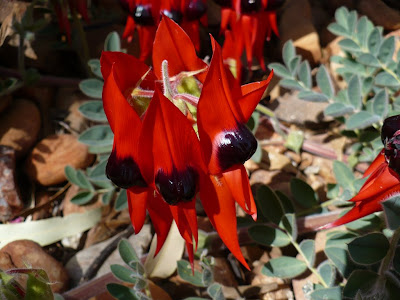
There are also acres of plants including some fantastic desert flowering plants, a favourite of ours is the scarlet and black desert pea.


Leaving Alice today to explore the East MacDonnell Ranges and then start the northward journey to Darwin...we may be some time.

Sunday, August 10, 2008

Ormiston Gorge

Having lodged at a house called 'Ormiston' while in Mudgee we felt obligated to visit Ormiston Gorge. It is reported to be the most spectacular gorge in the Western MacDonnells, and is a part of the Larapinta Trail

We have been doing bite sized chunks of this 223 km trail for the last few days. The Gorge has a near permanent waterhole, red river gums, and blood red walls rising to 300m. It was a 7km circular walk up to the top of the ridge and then down the gorge, but the weather was perfect with a cooling wind and not overwhelmingly hot.


You can run out of superlatives very easily trying to describe the landsape, it was a stunning walk.


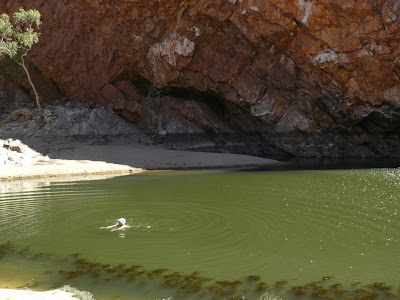
Ness ended the walk with a swim.

towards alice springs

Two days later we finally arrived at Alice Springs late in the afternoon. After days and days in the outback traffic lights and roundabouts seemed almost alien. There is only one caravan park in Alice which allows dogs, and pretty grim it was too. Surrounded by German Shepherds and packs of dingo hybrids, and caravans stuck together with gaffer tape it felt like a refugee camp, but we needed water, diesel, and the luxury of internet and telephone access.

Next morning we headed west to the West MacDonnell ranges. Mostly National Park but we have fine tuned dog smuggling and were determined to see what is reported to be one of the most stunning parts of the NT.

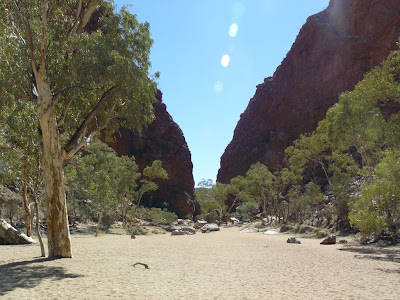
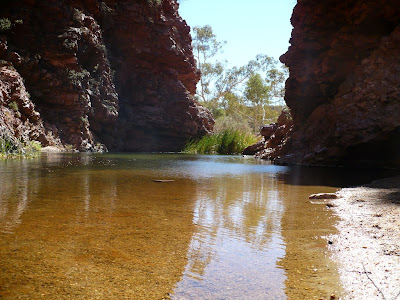
First stop Simpson's Gap, a waterhole at the end of a currently dry river and the habitat of the rare black-footed rock wallaby ( one unverified sighting by Ness ).


It was surprising to see water after days in the barren desert. It is 9 years since this region has had any rain to speak of, so the waterholes in the MacDonnell Ranges are hugely important for plant and animal species.

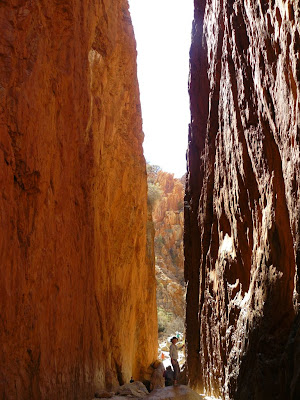
Standley Chasm was equally stunning, with cathedral height walls.


We found a dog friendly lookout point over the Ranges in which to camp and decided not to return to Alice dog ghetto.

Saturday, August 9, 2008

what a lot of rocks

After a week deep in the NT outback (apart from a short sojourn in Alice Springs), with no means of communication, it is about time I updated this blog.

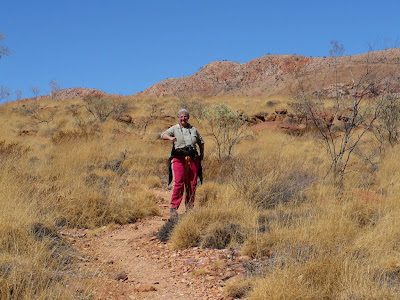
The interior of NT has numerous points of interest ( rocks ) interspersed by hundreds of km of points of boredom ( no rocks ) so a lot of ground has been covered since Uluru. Not only in the van either- Ness has been on a mission to get us fit so a lot of yomping over rocks, up cliffs, through gorges, across deserts, along dried up river beds and traversing canyons has been undertaken. Those of you who know me may find that difficult to believe, but I have hard photographic evidence for the cynical doubters.


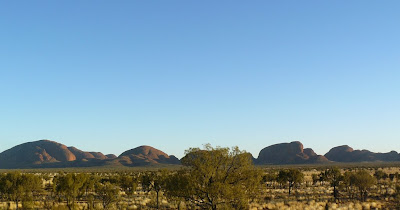
So, next stop after Uluru was Kata Tjuta ( The Olgas), 36 impressive steep sided domes 32 km to the west, sacred to the Anangu people.


We had a few short walks around the area, then we moved back towards the main highway to head up to Alice Springs ( 470 km).

We stopped at Curtin Springs, a basic roadhouse which offered free camping. The downside to the the site was a resident malevolent emu called 'Mungrel' which ranged freely creating havoc. When walking a small dog Mungrel would run from wherever she was hiding and initiate a full blown attack on dog and walker. Breakfast time was a great opportunity to nip into tents and steal toast, but her specialist subject was underwear. A makeshift clothesline was great sport and meant that she could peck, pick and pull at all the damp smalls until they were released and then trample them gleefully into the red dusty sand.

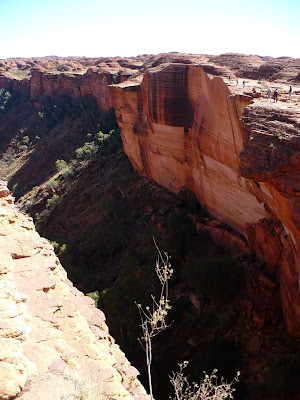
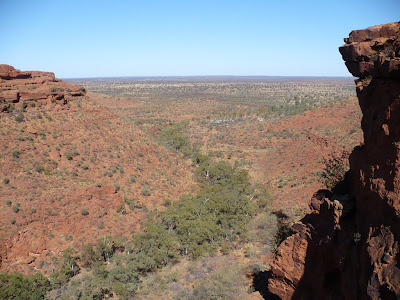
We braved emu carnage for 36 hours and then set off again, next stop Watarrka (King's Canyon) 300 km north of Uluru.This chasm cleaves the earth to a depth of 270 metres, providing shelter to a tropical oasis in the middle of arid surroundings.

I confess that I declined the 4 hour ridge walk after I saw the 100m near vertical ascent at the start, and elected to spend quality time with the dog, so all photos care of Ness who did the walk solo.


Smooth cliff face where there was a rock fall 60 years ago.


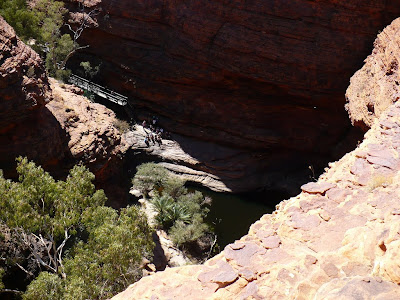
Above shows the Garden of Eden waterhole where Ness had her sandwiches.

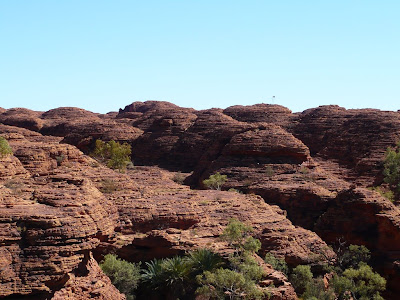
Above the 'beehives'

Saturday, August 2, 2008

round the big red rock

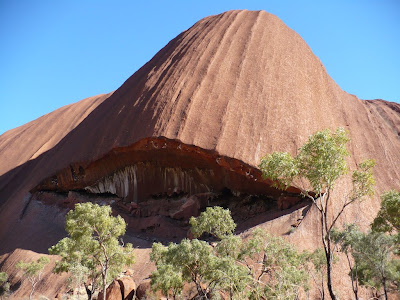
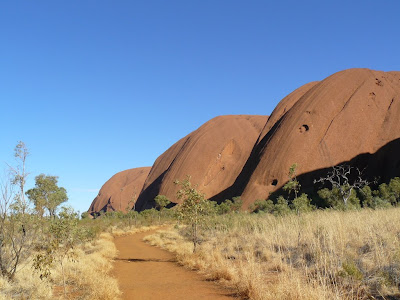
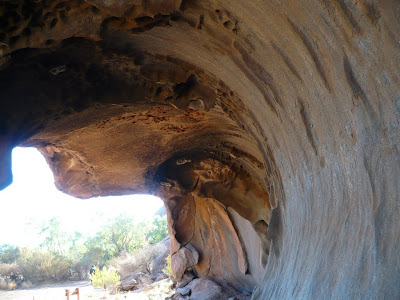
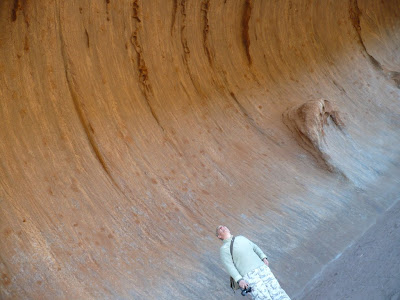
After the sunrise experience Ness decided that we had to to the walk all the way round the rock. This is a 10 km stroll all the way around the circumference, so we set off just after 8 am. It was still chilly and there were lots of other people around, but after an hour or so we realised that nobody else was doing the complete circuit, so for an hour or so there was just us and the rock, and the sunshine.


Neither of us managed to take pictures which did justice to the sheer size of it, and at many parts photography is forbidden due to the sacred nature of the site, but the walk was fantastic.


So, was it worth all the effort of getting there? I think it was.

I am not a great believer in geographical features having a 'spirituality' any more than I think dolphins, polished crystals or whale song are spiritual, but I accept that today we were in a part of the world that is extraordinary in many ways, and not only because of the presence of a great big lump of sculptural red rock.


Tomorrow we are off to explore 'The Olgas' ( Kata Tjuta ) the clump of smaller rocks 53 km from Uluru. Again we will be up before dawn to sneak James dog into the park and take pictures. We are then off deep into the NT outback, and will be without internet access until we reach Alice Springs, so no updates for a week or so.

We will sign off until then, spiritually fulfilled, physically knackered

to the big red rock

Travelling north from SA towards the Northern Territory en route to Uluru from Coober Pedy you start to wonder whether the journey to the renowned travel icon is really worth the effort. In fact you start to lose the will to live as km after km of unwinding desert road is negotiated.

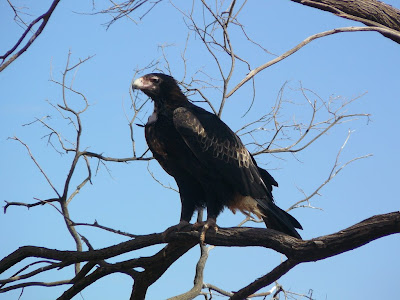
The trip, over 2 days, was 733 km. The only distractions on the journey were waving at the oncoming drivers, and watching the spectacular enormous wedge-tailed eagles feeding on road kill.

Ness took some time out and got up close; I was concerned they might think the little white thing was an easy meal but they must have decided she did not have enough meat on her to warrant the effort.


The road is interrupted every 20 km or so by cattle grids to divide the different cattle stations. James dog is petrified of the noise so spent 2 days in a state of high anxiety, to the point that on a pit stop she made a bolt for the desert and Ness had to run pretty swiftly to head her off. The solution was to wedge her in her bed in the bathroom well away from the cab noises.

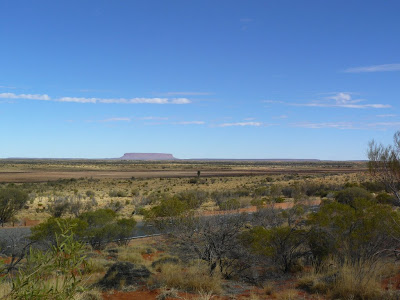
The first rock you encounter, 100 km before reaching Uluru, is Mount Conner, the third of the great monoliths of Central Australia. It is three times the size of Uluru and often mistaken for it by weary travellers, probably through desperation of wanting the trip to be over. It did serve to whet the appetite for the rest of the trip.


On finally reaching Yulara, a purpose-built 800-room town managed by the Voyages Hotel and Resort Group and serviced by Ayer's Rock airport 6 km away, you realise that the vast numbers of visitors are like shooting fish in a barrel for the tourist industry. Diesel is over 50% higher than anywhere else in the country, and hotel rooms and even basic camping cost a small fortune. Yulara is an aboriginal word meaning 'howling', and the local joke is that you'll be howling when you see your bill. We did have the advantage of being pretty self-sufficient with food and wine on arrival.

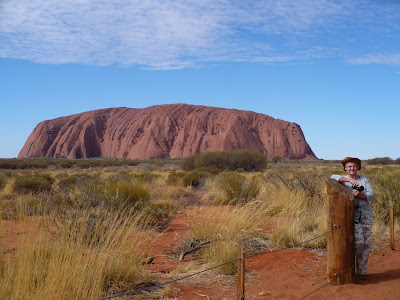
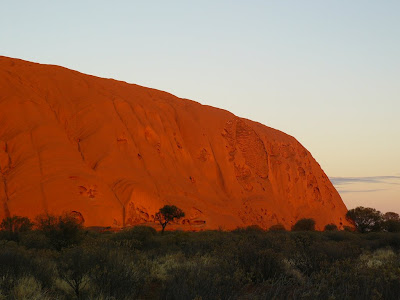
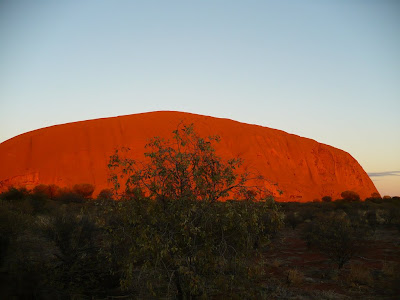
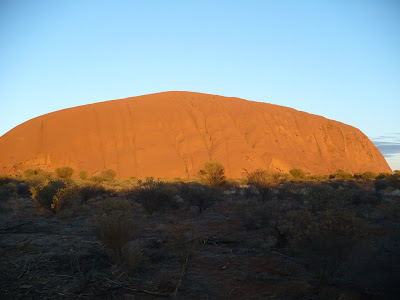
So, we were up at 5 am this morning in order to drive to the National Park and see Uluru at sunrise. With our illegal canine passenger stowed away in the bathroom we paid our entrance fee and went to the sunrise view point. With the usual double-standards of tourists we grumbled and complained about all the tour buses and selfish people there getting in the way and generally spoiling the photos, but the spectacular appearance of the glowing red mass was worth it.


Within 15 minutes the colour had changed to a dark yellow.