We have finally arrived on the outskirts of Darwin. Yesterday we took a detour towards Kakadu, a huge National Park SE of Darwin, but the area is so vast that we really need a few days there without the dog.
It is so hot and humid here that said dog is really suffering, so we by-passed Kakadu and spent today inspecting Helga's Pet Hotel near Darwin. For $16 per day james dog will be kept with a gang of other little dogs in a cool courtyard complete with their own plunge pool, so she is booked in for a week from Monday.
Meanwhile we will be exploring Darwin over the weekend, then will head back without dog to fully explore Kakadu and hopefully do a bit of 4WD off-roading.
Makes you realise what a huge country this is- I spoke to a friend in NSW who was driving through snow and here we are with temperatures in the high 30's and clawing humidity ( do not want to be here in the summer!).
Friday, August 22, 2008

Wednesday, August 20, 2008
katherine and nitmiluk national park
Katherine is the third largest town in the NT, and is home to the first permanent running water encountered by travelers along the road north from Port Augusta ( our route of almost 3000km)
To see a large river after so long in the desert seems almost alien.
Yesterday we took a boat tour through 3 of the River Katherine's gorges ( there are 13 gorges, 5 accessible by boat). As winter is the dry season and the river is low, the tour was a combination of boat and walking between gorges to pick up a second and then a third boat.
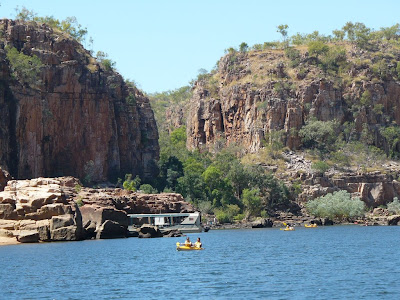
In the wet season the river levels will rise by up to 7 metres ( and in 1998 the town was flooded with over 3 metres of water flowing through). So the boats are taken upstream in the wet season and moored in each of the first 3 gorges to facilitate the dry season tours.

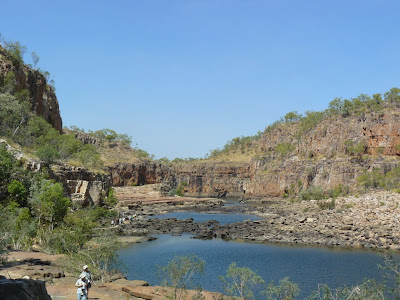
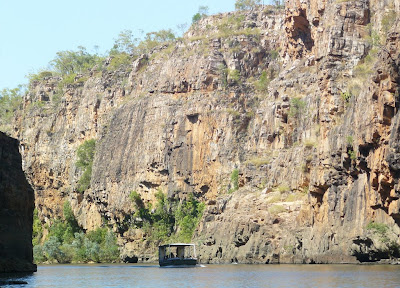
With temperatures in the mid 30's, a swim was most welcome.......
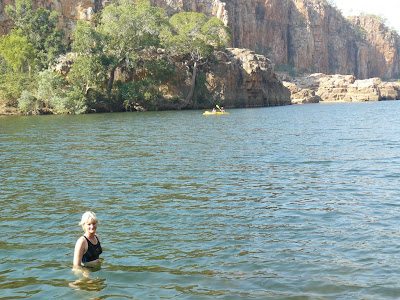
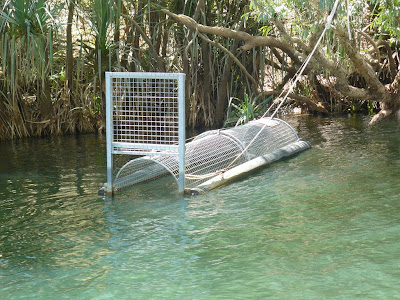
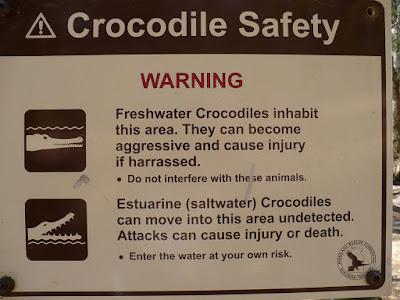
........ though I am not sure how much confidence the presence of salt water crocodile traps engendered.
To see a large river after so long in the desert seems almost alien.
Yesterday we took a boat tour through 3 of the River Katherine's gorges ( there are 13 gorges, 5 accessible by boat). As winter is the dry season and the river is low, the tour was a combination of boat and walking between gorges to pick up a second and then a third boat.
In the wet season the river levels will rise by up to 7 metres ( and in 1998 the town was flooded with over 3 metres of water flowing through). So the boats are taken upstream in the wet season and moored in each of the first 3 gorges to facilitate the dry season tours.
With temperatures in the mid 30's, a swim was most welcome.......
........ though I am not sure how much confidence the presence of salt water crocodile traps engendered.
katherine school of the air
The NT covers a large area- it is approx three times the size of the United Kingdom-so over 250 isolated children have to be educated using distance learning ( students on cattle stations, Aboriginal communities, and families who are traveling throughout Australia or overseas). This covers all families who are over a 2 hour drive from the nearest school or over an hour from a school bus route.
Katherine School of the Air began operating on 12 September 1966. Not only was this the first School of the Air service to students in the Top End of the Northern Territory but it was the first broadcast of a School of the Air made independently of other services (such as the Royal Flying Doctor Service in Australia). Radio lessons for the Katherine School of the Air at that time were supplementary to correspondence courses supplied by the South Australian Correspondence School.
Since 2006 the NT has developed an internet distance learning system, and we went to a lecture and demonstration, and watched the teacher running a maths class. The kids can see the teacher through several webcams, and all interaction is via an instant messaging system. The kids will be in small groups where possible, but many are solitary.
Where families are eligible, the IT specialist hops into his aeroplane and flies out and installs a complete satellite internet system at their homes, at a government subsidised cost to the participants of $300 per year. Equipment and paperwork for lessons is sent by post. Teachers will visit each student at least once a year, and the total distance travelled by either road or plane averages over 120, 000 km per year.
Once a year the kids all get together for school camp. The organisation and dedication of the staff was palpable and the talk extremely interesting.
More details on their website Katherine School of Air
Katherine School of the Air began operating on 12 September 1966. Not only was this the first School of the Air service to students in the Top End of the Northern Territory but it was the first broadcast of a School of the Air made independently of other services (such as the Royal Flying Doctor Service in Australia). Radio lessons for the Katherine School of the Air at that time were supplementary to correspondence courses supplied by the South Australian Correspondence School.
Since 2006 the NT has developed an internet distance learning system, and we went to a lecture and demonstration, and watched the teacher running a maths class. The kids can see the teacher through several webcams, and all interaction is via an instant messaging system. The kids will be in small groups where possible, but many are solitary.
Where families are eligible, the IT specialist hops into his aeroplane and flies out and installs a complete satellite internet system at their homes, at a government subsidised cost to the participants of $300 per year. Equipment and paperwork for lessons is sent by post. Teachers will visit each student at least once a year, and the total distance travelled by either road or plane averages over 120, 000 km per year.
Once a year the kids all get together for school camp. The organisation and dedication of the staff was palpable and the talk extremely interesting.
More details on their website Katherine School of Air
Tuesday, August 19, 2008
....more rocks
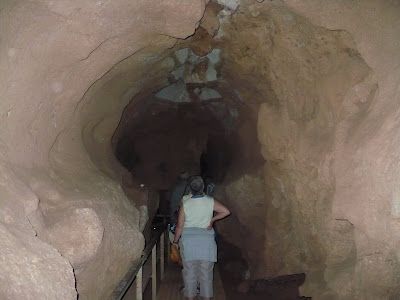
Today we went to look at Cutta Cutta Caves, another limestone cave with stalactites and stalagmites but with a twist. The cave is home to 5 species of bat including rare ghost and horseshoe bats, and has an underground pool which is the habitat of a blind shrimp species found nowhere else on the planet.
The brown tree snake lives in the cave and hangs out on ledges grabbing bats as they fly out of the cave at night. There were none to be seen when we were there, but we did see shed snake skins hanging from stalactites. The snakes grip on to the rocks and dangle while they wriggle out of their skins.
The traditional owners of the land, the Jawoyn, named the caves Cutta Cutta- meaning many stars- because they believed that the sparkly calcite in the rock was where stars lived during the day.
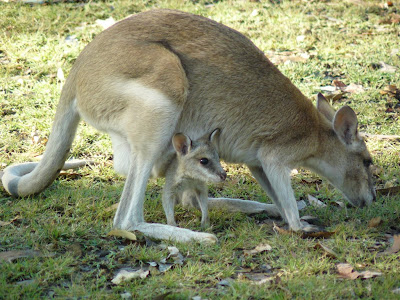
We are now in Katherine a large town 300 km south of Darwin, and plan to explore more thermal springs tomorrow. The residents of the campsite are very bold 'agile wallabies' which are driving james dog demented by sneaking up on her while she is not paying attention.
The brown tree snake lives in the cave and hangs out on ledges grabbing bats as they fly out of the cave at night. There were none to be seen when we were there, but we did see shed snake skins hanging from stalactites. The snakes grip on to the rocks and dangle while they wriggle out of their skins.
The traditional owners of the land, the Jawoyn, named the caves Cutta Cutta- meaning many stars- because they believed that the sparkly calcite in the rock was where stars lived during the day.
We are now in Katherine a large town 300 km south of Darwin, and plan to explore more thermal springs tomorrow. The residents of the campsite are very bold 'agile wallabies' which are driving james dog demented by sneaking up on her while she is not paying attention.
water, fish and swimming
Very close to Darwin now, and the terrain and weather have changed dramatically- much greener and considerably warmer.
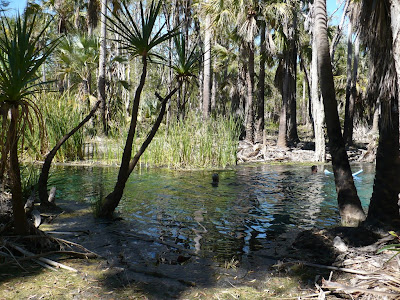
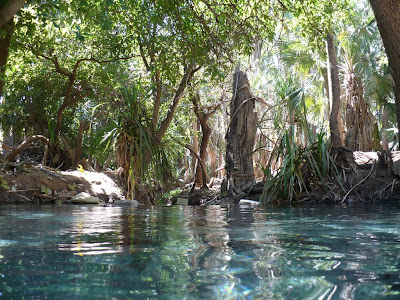
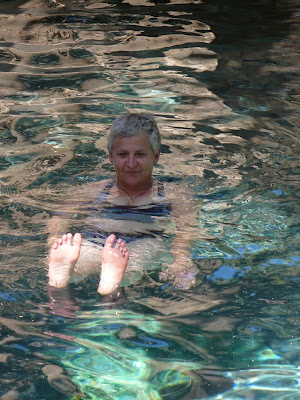
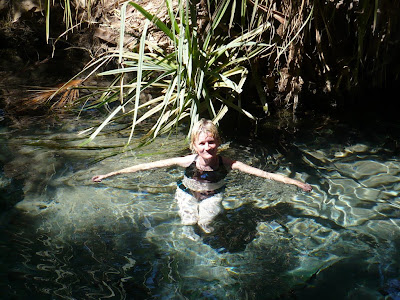
At Mataranka we went to two different 'thermal' pools which are springs alongside the Roper River fed from pools in the limestone 100m below the surface which ensures a constant 34 degrees water temperature. Surrounded by exotic palm trees the pools are great to swim in, providing a great free spa treatment for the paupers in a van.
But, as this is Australia, there are hazards and pitfalls on the periphery of all pleasures and adventures.
Barramundi fishing is a big sport here, as these fish thrive in environments where fresh water meets salt water. They are enormous fish, up to 1.5 metres in length and 55 kg in weight, and are quite willing to jump great heights for a feed as we discovered when we went to a fish feeding demonstration.
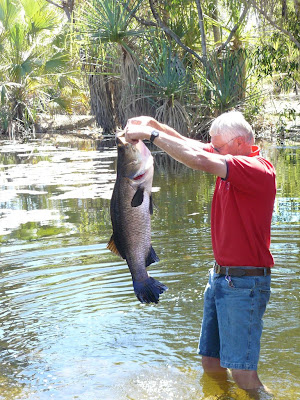
My favourite barramundi fact is that they are all born as males but when they reach salt water the majority of them change into females. Sex change provides a method whereby the larger, more successful individuals (the female fish) are able to make the greatest contribution to the genetic material of a stock.
This fact conjures up all sorts of possibilities if our species could do the same. A misogynist's coach tour to the seaside for a lovely swim for example.
At Mataranka we went to two different 'thermal' pools which are springs alongside the Roper River fed from pools in the limestone 100m below the surface which ensures a constant 34 degrees water temperature. Surrounded by exotic palm trees the pools are great to swim in, providing a great free spa treatment for the paupers in a van.
But, as this is Australia, there are hazards and pitfalls on the periphery of all pleasures and adventures.
Barramundi fishing is a big sport here, as these fish thrive in environments where fresh water meets salt water. They are enormous fish, up to 1.5 metres in length and 55 kg in weight, and are quite willing to jump great heights for a feed as we discovered when we went to a fish feeding demonstration.
My favourite barramundi fact is that they are all born as males but when they reach salt water the majority of them change into females. Sex change provides a method whereby the larger, more successful individuals (the female fish) are able to make the greatest contribution to the genetic material of a stock.
This fact conjures up all sorts of possibilities if our species could do the same. A misogynist's coach tour to the seaside for a lovely swim for example.
Monday, August 18, 2008
destination for the 'beauty-disadvantaged'
A fair dinkum typical male Australian quote from John Molony mayor of Mount Isa urging ugly women to flock to the isolated town where the ratio of men:women is 5:1.
Rumours that sexism is dead are grossly exaggerated.
Rumours that sexism is dead are grossly exaggerated.
daly waters pub
The best outback pub we have visited to date has to be the Daly Waters pub north of Tennant Creek. Built in the 1930's to service early Qantas passengers on a refuelling stop, this wrought iron building has been serving customers ever since. It also has a handy campsite next door.
Opening hours are 7 am, closing time when the last man standing stops ordering drinks. Rumour had it that pancakes breakfasts were available at 4 am but we did not manage to stay awake to verify it.
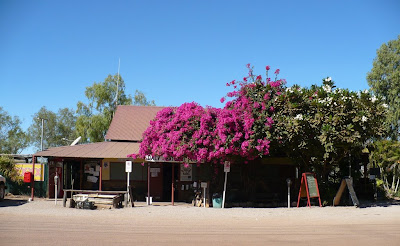

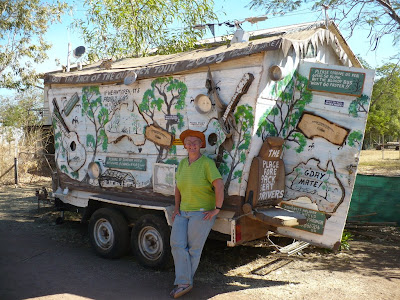
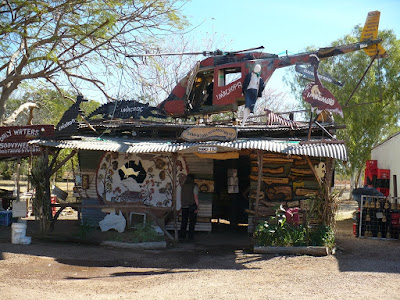
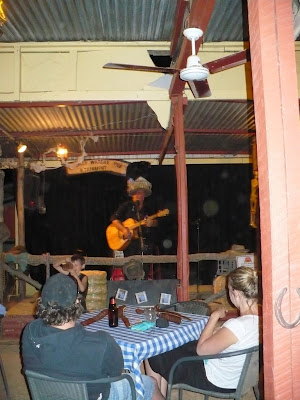
We were treated to a beef and barramundi barbecue, with country music, yarns and jokes from resident entertainer 'Frank the Chookman'. The best ever act we have seen involving a man singing with a chicken on his head.
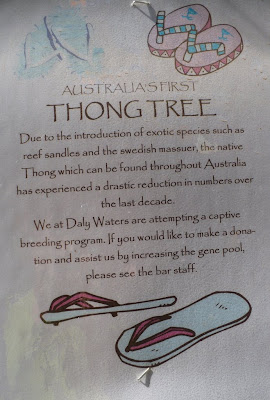
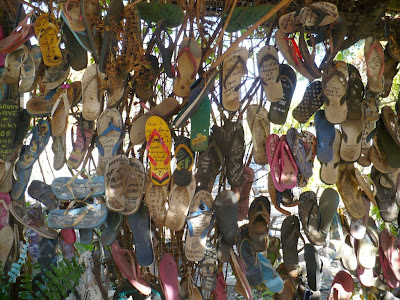
The interior is decorated with a vast array of very dusty signed undergarments, and we were very taken with the thong tree.
Opening hours are 7 am, closing time when the last man standing stops ordering drinks. Rumour had it that pancakes breakfasts were available at 4 am but we did not manage to stay awake to verify it.
We were treated to a beef and barramundi barbecue, with country music, yarns and jokes from resident entertainer 'Frank the Chookman'. The best ever act we have seen involving a man singing with a chicken on his head.
The interior is decorated with a vast array of very dusty signed undergarments, and we were very taken with the thong tree.
Subscribe to:
Posts (Atom)